Cleaning Units Explained: PSI × GPM Decoded
By Lian Zhou • 15th Mar
Cleaning Units aren't just an industry term, they are your bridge between pressure washer specifications and real-world results on your deck, driveway, or siding. Once you understand how to calculate and apply them, you'll stop guessing whether a machine will damage your cedar or struggle on concrete, and start choosing setups with confidence.
The Problem: Specs Without Direction
When you're shopping for a pressure washer, you see PSI and GPM numbers everywhere. A homeowner or small operator naturally asks: which matters more? Is 3,000 PSI always better? Does higher GPM mean faster cleaning? Without a unifying framework, these numbers feel disconnected, and so does your purchasing decision. You buy based on whichever spec looks impressive, then discover it's wrong for your surfaces.
The result? Inconsistent outcomes. A setup that powered through algae on your concrete neighbor's patio etches your own composite deck. A gentle machine that's safe for wood barely touches oxidation on your vinyl siding. Hours of trial-and-error replace actual cleaning.
This confusion exists because PSI and GPM do different jobs. They aren't rivals; they are a team. And until you see them as a team, you'll keep buying machines that don't fit your actual needs.
Understanding PSI and GPM: Force and Flow
PSI (Pounds per Square Inch) measures the force of water against a surface. It is what breaks the chemical bond between dirt, mold, or grease and your finish. Think of PSI as the "stripping" action, the aggressive push that dislodges stubborn contaminants.
GPM (Gallons per Minute) measures the volume of water flowing through the machine. It is the "rinse" power that carries away loosened debris and detergent. A higher GPM shortens washing time on large areas; a lower GPM means you'll loop the same patio twice to rinse it clean. If your spigot or well can't sustain that flow, troubleshoot setup and low-pressure fixes in our water supply guide.
The insight that changed how I test surfaces? Start with the surface; pressure is the last knob. A hardened concrete driveway might tolerate 3,000 PSI, but the grain direction and wood species of your deck dictate what works on cedar. I've seen operators crank PSI on wood, watch the fuzzing spread, then blame the "cheap" deck. The machine wasn't bad, it was mismatched to the finish. On test panels, dropping from 1800 PSI to 1100 PSI, adjusting nozzle angle to 40°, and layering in extra dwell time with an oxygen cleaner stopped the fuzzing cold, held color consistency, and eliminated drying lines.
That's not compromise; it is finish-safe optimization.
Cleaning Units: The Unified Metric
Cleaning Units (CU) combine PSI and GPM into a single performance score using this formula:
Cleaning Units (CU) = PSI × GPM
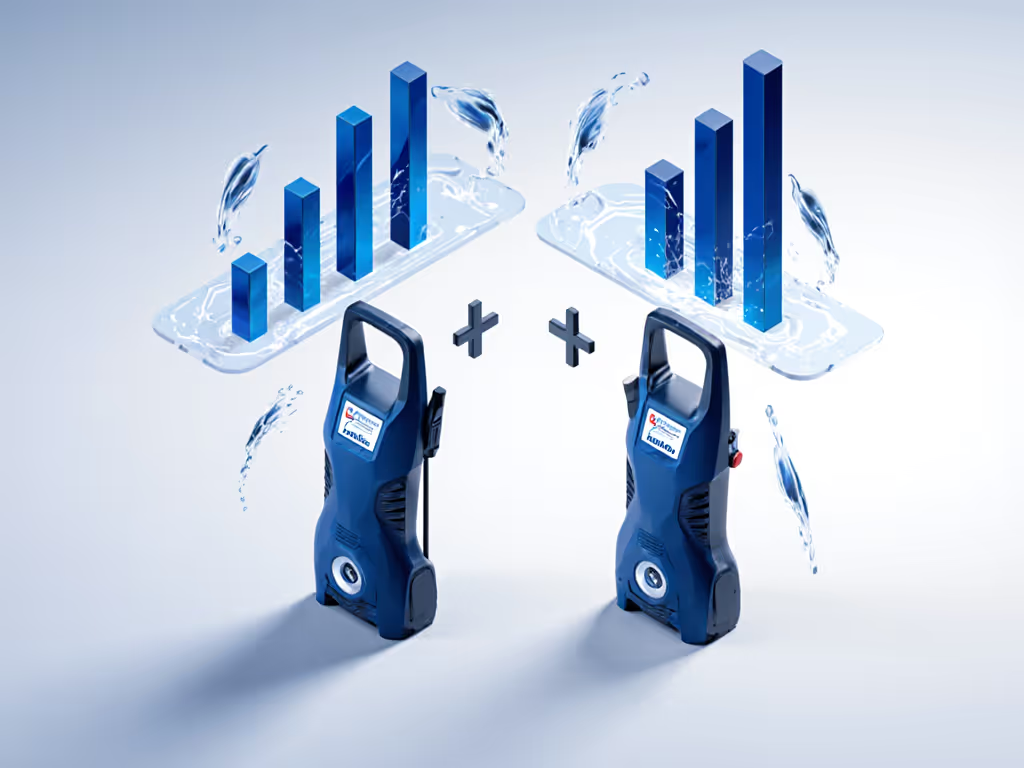
This metric reveals a critical truth: two machines with wildly different PSI and GPM values can deliver equivalent total cleaning power. A 3,000 PSI / 2 GPM washer produces 6,000 CU, just like a 2,000 PSI / 3 GPM unit. But they'll perform very differently on your specific surfaces.
Consider this real example:
- Pressure washer A: 3,000 PSI × 2.0 GPM = 6,000 CU
- Pressure washer B: 2,000 PSI × 3.0 GPM = 6,000 CU
Both machines have identical CU ratings, yet Pressure washer B rinses dirt away faster because higher GPM means more water is moving debris off the surface. Pressure washer A strips more forcefully but requires more passes to rinse.
Which one is "better"? That depends on your surfaces. For a wood deck, you'd likely prefer lower PSI with higher GPM and extended dwell time, a finish-safe threshold approach. For concrete stains, you might want the extra force of higher PSI, balanced by adequate flow.
Safe Cleaning Unit Ranges by Surface Type
The surface dictates setup, including the CU range you should operate within. Here's where most operators stall: they don't know the "green zone" for each material.
For gentle washing (wood furniture, painted surfaces, delicate finishes): aim for 1,200–2,700 CU, using PSI ranges of 1,200–1,800 and GPM of 1.0–1.5. This band protects wood grain, prevents raised fibers, and minimizes oxidation risk on coated metals.
For general home cleaning (siding, driveways, sidewalks): 3,000–5,000 CU is your working range, with PSI of 2,000–2,500 and GPM of 1.5–2.0. This balances stripping power with safe rinsing for most residential finishes.
For heavy-duty stains (grease on concrete, industrial cleaning): 5,000–10,500 CU is appropriate, using PSI of 2,500–3,500 and GPM of 2.0–3.0. Here, force becomes essential, and standoff distance becomes your pressure control lever, and keeping 18-24 inches away gives you the cleaning power without over-aggressive impact.
These aren't arbitrary numbers. They reflect finish-safe thresholds tested across materials and problem types. The key is matching both PSI and GPM to the surface, not chasing one metric in isolation.
How Standoff Distance and Dwell Time Extend CU Strategy
Calculating CU is just the starting point. You still need two more control variables: standoff distance (how far the nozzle is from the surface) and dwell time (how long detergent sits before rinsing).
Standoff distance directly affects the effective PSI delivered to the surface. At 12 inches, your 2,000 PSI washer may hit the surface at 1,500 PSI due to water dispersion. At 24 inches, that same machine might only deliver 900 PSI. This is how experienced operators bring aggressive specs down to finish-safe levels without compromising the machine itself.
Dwell time allows detergent and oxidation-removal chemistry to break chemical bonds instead of relying solely on pressure. For selection and dilution basics, see our detergent chemistry guide. A mild detergent + longer dwell often delivers results that high PSI alone cannot, and with far less risk to wood grain or composite coatings.
Together, with the right CU band, appropriate standoff, and proper dwell, you unlock efficient, repeatable cleaning. You're no longer hoping pressure alone will work.
Comparing Machines: CU Puts You in Control
When evaluating pressure washers, calculate the CU and then cross-reference it against your most common surface type. A light-duty machine rated at 1,800 CU suits deck and vehicle work. A medium-duty 3,750 CU unit handles mixed residential jobs. A heavy-duty 6,000 CU machine tackles commercial concrete or grease-heavy work.
But don't stop there. Ask yourself:
- What's the GPM relative to the PSI? (Higher GPM = faster rinsing on your specific tasks.)
- Can I adjust PSI or nozzle angle? (Flexibility matters for surfaces with varying sensitivity.)
- Is flow rate sufficient for my surface cleaner or foam cannon? (Undersized GPM starves accessories and creates bottlenecks.) To size your tool correctly, use our surface cleaner comparison to match diameter and nozzle orifice to your GPM.
These questions move you from spec-checking to surface-first thinking.
Your Actionable Next Step
Make a simple reference table right now: list your main surfaces (deck, driveway, siding, fence, vehicles), note the material for each, and write down the CU range that's safe from the chart above. Then, when you're evaluating a pressure washer, calculate its CU and ask: does this unit sit in the right band for 70% of my work?
If yes, verify that the PSI and GPM split works for your standoff and dwell comfort. If the machine is high-PSI/low-GPM, confirm you're willing to make multiple passes to rinse. If it's low-PSI/high-GPM, confirm you have strong detergent and dwell time in your workflow.
This one practice, matching CU to surface and layering in standoff and dwell, eliminates the guesswork and stops you from buying wrong the first time.
Related Articles