Comparing Smart Pressure Washers: IoT Data & Performance
By Maya Okafor • 10th May
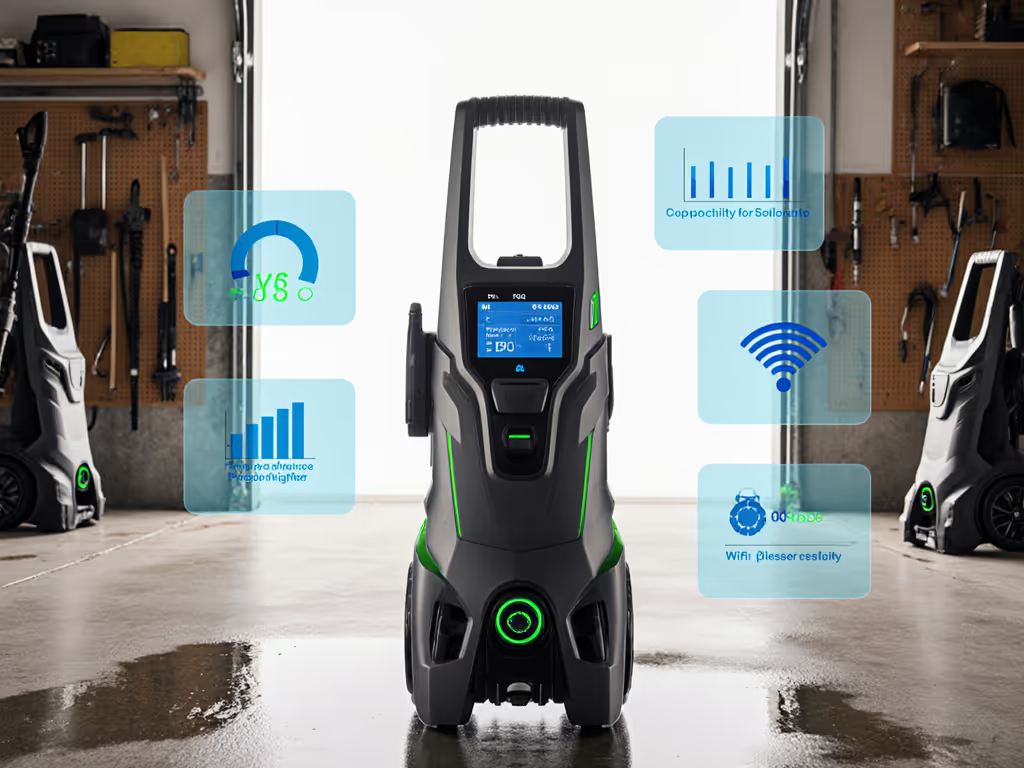
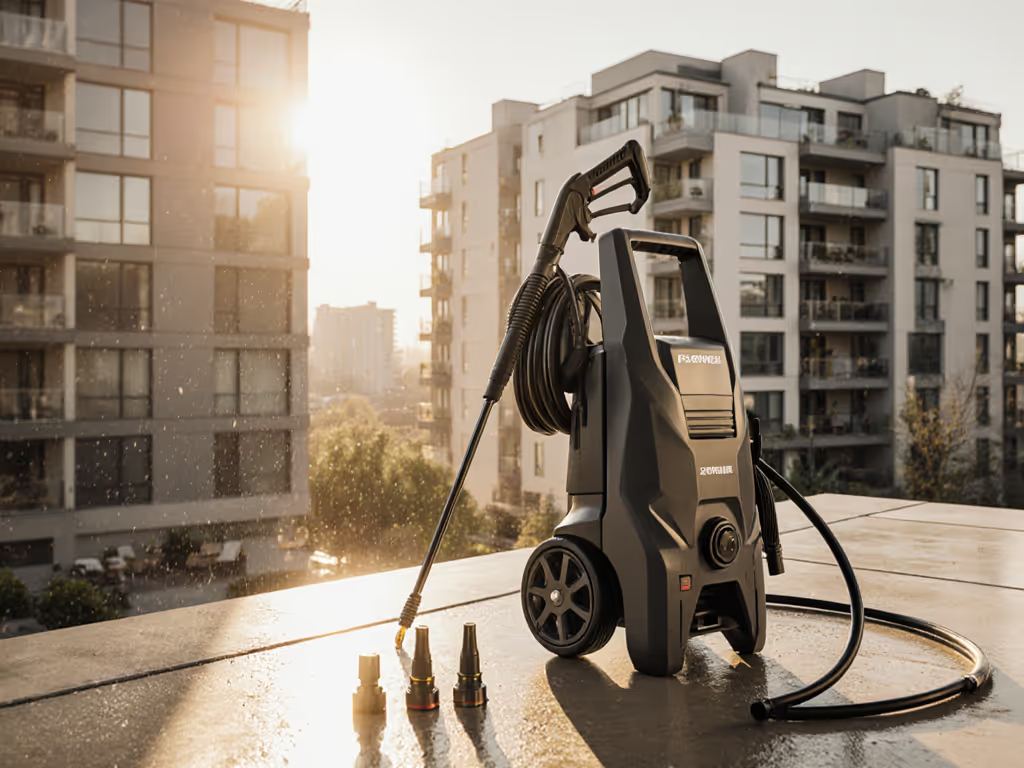
Smart pressure washer technology and IoT pressure washer comparison have evolved from novelty into practical tools for homeowners and small operators who demand consistency, control, and damage-free results. If you've ever hesitated before pulling the trigger on your pressure washer (worrying you'll etch a customer's deck, blow mortar from brick joints, or chalky-streak your own aluminum trim), you're not alone. The rise of connected devices with app-controlled pressure washing, usage data analytics, smart home integration, and remote diagnostics features promises a solution: real-time feedback and decision support before costly mistakes happen.
But do these data-rich tools actually deliver on that promise? And which smart features genuinely matter for finish-safe cleaning?
What Makes a Pressure Washer "Smart"? Understanding IoT Capabilities
Beyond the Basic Button
A "smart" pressure washer connects to your smartphone or home automation hub via WiFi or Bluetooth, logging operational data throughout each job. The baseline features typically include:
- Power-on/shutdown via app: Start or stop the motor remotely; some models auto shutoff after idle timeout to preserve pump life.
- Real-time PSI and GPM readouts: Digital display of operating pressure and flow rate, streaming to your device.
- Usage data analytics: Cumulative hours, total gallons dispensed, pressure cycles, and thermal events tracked over time.
- Alert notifications: Warnings for overheating, low water supply, or pressure anomalies before they damage the pump or your work.
- Historical job logging: Date-stamped records of every cleaning session, useful for troubleshooting repeat issues or documenting service history.
- Smart home ecosystem hooks: Integration with platforms like Amazon Alexa or Google Home for voice commands and automation workflows.
- Remote diagnostics: Manufacturers can access fault codes and performance telemetry to guide troubleshooting or recall alerts.
Some premium models add pressure regulation presets tied to surface type (e.g., "concrete," "wood," "composite"), though these blanket settings require verification on your specific surfaces before full-scale deployment. For the newest control features and sensors in upcoming models, see our 2025 smart control innovations.
Can IoT Data Really Help You Avoid Damage?
The Data-Safety Connection
Yes, but with nuance. Real-time PSI feedback addresses one critical pain point: specification confusion. If you're unsure how pressure and flow work together, start with our PSI vs GPM guide. You may read that a machine outputs "3,000 PSI," but that doesn't tell you what happens when you hold a 0° tip six inches from a cedar fence. IoT-enabled live readouts let you see actual pressure at standoff and adjust nozzle fan angle or distance before contact (the essence of contact minimization).
However, pressure data alone doesn't capture the full finish-safety picture. A pressure washer may report 1,800 PSI, but if you pair it with a narrow-orifice tip and no pre-treatment, you'll still risk tiger-striping vinyl siding or opening wood grain. This is where chemistry does the heavy lift; pressure just rinses smartly, and app data should guide how you rinse, not just at what PSI. To build safer mixes backed by science, read our detergent chemistry explainer.
Consider a real scenario: a property owner with oxidized aluminum rails, similar to a wagon owner who initially fought chalky streaks under poorly chosen spray angles and abrasive pressure settings. The shift wasn't a smarter pressure washer; it was a smarter recipe. When we ditched the narrow tip, deployed a foam pre-wash with mild chelating wash, extended dwell time, and rinsed at a wider fan angle from farther back, the streaks stopped appearing, rubber trim stayed dark, and the paint's gloss meter actually rose post-dry. The IoT feature that mattered most was one that logged the successful pressure and angle, so we could replicate it across future jobs.
Chemistry first, pressure last. IoT data is most powerful when it logs your proven, finish-safe recipes, not when it tempts you to dial pressure ever higher.
Pressure Curves and Thermal Events
Usage data analytics also expose a hidden risk: thermal cycling stress. Cheap pressure washers without bypass unloaders run continuously at max PSI even when the trigger is released, causing the pump to overheat. Smart washers with onboard temperature and pressure logging can alert you when the pump is creeping toward the red zone, prompting you to pause and cool down or step back to a lower-pressure mode. This prevents premature pump failure and, on coated metals like aluminum or galvanized steel, reduces the micro-vibration etching that occurs during prolonged high-pressure idle.
App-Controlled Pressure Washing: Convenience vs. Necessity
When Remote Control Matters
Remote on/off via app is less about luxury and more about workflow safety and efficiency:
- Rinsing while adjusting nozzles: Pause the motor from a distance without returning to the pump, reducing hose strain and repositioning time.
- Neighbor courtesy: In noise-sensitive neighborhoods or HOAs, schedule startup/shutdown via phone at agreed times rather than firing up the engine at dawn.
- Water supply monitoring: Start the motor only after confirming spigot flow is adequate, minimizing dry run pump damage.
- Multi-surface jobs: Switch pressure presets (if available) between surfaces and confirm readiness before the trigger is squeezed.
The Catch
App latency can be problematic in high-pressure situations. A 1 to 2 second WiFi delay during active spraying is a non-starter; remote control works best for start/stop, not mid-spray adjustments. Most users will still grip the trigger physically for fine control. The real win is logging every session, not replacing tactile feedback. Keep that expectation in mind.
Usage Data Analytics: Water, Pressure, and Compliance
Budgeting Gallons Per Job
One of the thorniest pain points is water uncertainty. A homeowner in a drought-prone state or a mobile detailer with tanker constraints desperately needs to know: "Will this job consume 40 gallons or 140?"
IoT-enabled GPM logging answers this directly. Over 10 comparable jobs (e.g., driveways cleaned with the same detergent and dwell time), you'll see a range, say, 85 to 110 gallons. That data becomes your budget baseline. For proven ways to lower gallons without sacrificing results, see our water conservation guide. Smart dashboards can even auto-alert you mid-job if gallons dispensed exceed the threshold, prompting a pivot to a more efficient technique.
This is especially valuable for:
- Small operators: Knowing water consumption per square foot helps price jobs accurately and avoid overage charges at rental properties.
- HOA compliance: Some jurisdictions cap water use per residential lot. Logged data proves your process is efficient and can help negotiate exceptions.
- Environmental responsibility: Homeowners eager to minimize water waste appreciate the transparency; it aligns with the identity of a conscientious neighbor.
Pressure Staging and Energy Efficiency
If your machine supports multi-stage pressure mode (e.g., 1,500 PSI for final rinse, 2,500 for agitation), historical logs show which mode you actually used and for how long. Over time, you'll discover that 60% of your jobs are successfully completed at lower pressure, reducing fuel consumption (for gas) or electricity draw (for electric). This insight cascades into lower operating costs and, paradoxically, safer results, since lower pressure means less risk of damage.
Remote Diagnostics Features: Proactive Maintenance and Reliability
Pump Health Monitoring
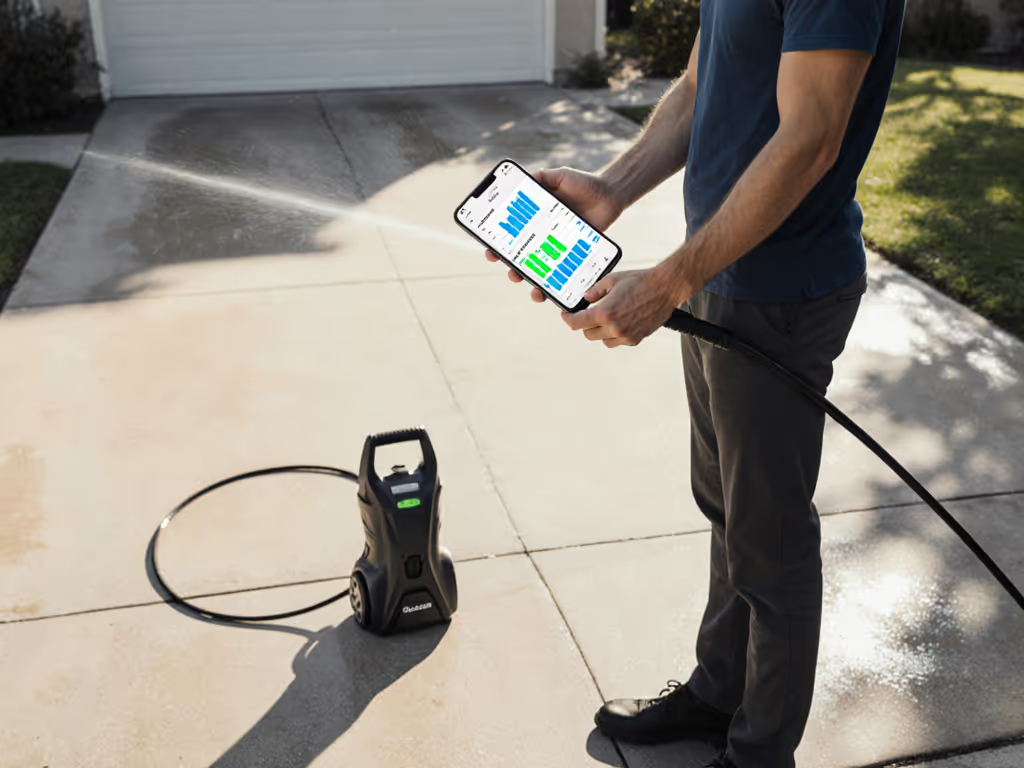
A smart pressure washer continuously logs pressure and flow curves. When these diverge from baseline (e.g., pressure drops 15% at the same nozzle and input, signaling pump wear or seal degradation), the system flags it. You learn about looming pump failure before you're stranded mid-job, not after an emergency call to your supplier.
For mobile operators and small crews, this translates to:
- Fewer job cancellations: Preventive maintenance replaces emergency downtime.
- Predictable replacement cycles: Budget for a new pump in Q3, not an urgent $800 weekend call.
- Liability proof: Documented maintenance records defend against claims that neglect caused poor results.
Fault Code Translation
Traditional machines blink fault lights that users misinterpret. A smart washer transmits fault codes to the manufacturer's cloud platform, which auto-populates troubleshooting steps: "Error 23: Intake water pressure low. Check spigot valve, hose kinks, or inlet filter. Restart after correcting." This is a massive quality-of-life improvement for DIYers and small operators who don't have a repair technician on speed dial.
Smart Home Integration: Why It Matters (and When It Doesn't)
The Integration Ecosystem
Smart home integration means your pressure washer responds to routines, automations, and voice commands. Example workflows:
- "Alexa, start the patio cleaner.": The machine powers on without walking to the garage.
- Geofencing automation: Your pressure washer auto primes when your phone approaches home, ready to use the moment you arrive.
- Routine linking: "Summer Weekend" routine starts the washer, opens the garage, and sends a notification when ready, all with one voice command.
Realistic Value Proposition
For homeowners, integration is a nice-to-have that smooths friction in weekend cleaning routines. For property managers overseeing multiple units, a centralized dashboard where you can check power status across 10 washers in different buildings is a genuine efficiency multiplier.
However, don't conflate integration with cleaning intelligence. Voice control and automation address logistics, not finish-safety. You still need to manually verify pressure, nozzle choice, and surface condition before the washer fires up.
Comparing Smart Models: The Decision Framework
Key Metrics Beyond Marketing
When evaluating smart pressure washers, move past brand hype and focus on:
- Baseline specs (PSI/GPM): Confirm the machine's power class suits your most demanding surface.
- Pressure regulation range: Does it support 1,000 to 3,000 PSI steplessly, or is it locked at one pressure?
- Data granularity: Real-time PSI/GPM, or just on/off logging?
- Alert sensitivity: Can you customize thresholds for thermal shutdown or water supply warnings?
- Ecosystem lock-in: Is the app agnostic, or tied to one manufacturer's ecosystem (limiting future upgrades)?
- Nozzle compatibility: Can you use third-party tips, or are you forced into proprietary orifices?
- Runoff control: Does the machine support low-pressure foam pre-wash modes and chelation recipes, or only high-pressure blasting?
- Total cost of ownership: Upfront price, pump replacement intervals, software subscription fees (if any), and component longevity.
A Practical Checklist
Choose a smart model if:
- You're a small business operator managing multiple jobs and need efficiency data.
- You live in a water-constrained region and want gallons-per-job transparency.
- Your neighborhood has noise ordinances; you want to prove scheduled, low-decibel operation.
- You plan to keep the machine 5+ years and benefit from predictive maintenance alerts.
- You own multiple smart home devices and appreciate unified voice control.
A traditional (non-smart) model may suffice if:
- You clean infrequently (fewer than 10 times per year) and don't benefit from logged data.
- You prioritize simplicity and mechanical reliability over telemetry.
- Budget is the primary constraint; smart models typically cost $100 to $300 more.
- Your surfaces are straightforward (concrete only) and don't require recipe optimization.
ROI and Total Cost of Ownership
The Financial Case
A mid-range smart pressure washer (2,500 PSI, 2.5 GPM) runs $600 to $900. A comparable non-smart model costs $400 to $650. The premium ($150 to $300) is recovered through:
- Reduced water waste: Data-driven efficiency cuts gallons per job by 10 to 20%, saving $5 to $15 per job over a season.
- Avoided damage rework: Alerts that prevent catastrophic pressure mistakes or thermal failures eliminate the cost of pump replacement or customer callbacks.
- Faster job completion: Logged recipes and preset adjustments cut setup time by 15 to 20 minutes per job; over 50 jobs annually, that's 12 to 16 hours reclaimed.
- Maintenance predictability: Proactive seal/pump replacement before failure extends machine life and prevents emergency downtime.
For a property manager or small operator running 100+ jobs per year, the ROI is typically positive within 12 months. For a weekend homeowner doing 5 to 10 jobs annually, payback extends to 3 to 5 years; the appeal shifts from financial ROI to convenience and peace of mind.
Finish-Safe Recipes and Smart Pressure Data
Logging Your Proven Approach
One underutilized strength of IoT pressure washers is the ability to document and replicate finish-safe recipes. Here's how:
- Clean a challenging surface (e.g., composite deck or oxidized aluminum) using a low-PSI foam pre-wash, mild chelating detergent, extended dwell, and wider nozzle fan angle at controlled distance.
- Log the result: pressure setpoint, GPM, dwell minutes, standoff distance, and nozzle angle.
- Review the post-dry outcome (gloss meter reading, absence of etching or streaking).
- Future similar surfaces? Retrieve the logged recipe and execute identically.
This is not replacing guesswork with blind trust in app presets. Rather, you're building a personal database of finish-safe protocols, proven on your equipment in your climate, on your specific surfaces. Over time, that data becomes more valuable than the machine itself.
Final Thoughts: Smart Features as Finish-Protection Enablers
Smart pressure washer technology serves homeowners and operators best when it reinforces discipline: measure before you scale pressure, log what works, and let data prevent costly improvisation.
The core promise, consistency and damage avoidance, is real. But it demands that you treat app data not as permission to cut corners, but as a guardian of best practices. When combined with finish-protective chemistry (foam pre-wash, mild chelation, extended dwell, and runoff control), IoT logging becomes a bridge from trial-and-error to repeatable excellence.
Chemistry first, pressure last, and let your smart machine's data validate every step along the way.
Want to Explore Further?
Ready to dig deeper? Consider these next steps:
- Compare specific models using the decision checklist above; look for third-party reviews that report real-world PSI/GPM consistency, not just marketing claims.
- Test recipes locally: Borrow or rent a smart washer for one weekend on your problem surfaces (deck, siding, driveway) and log the results before committing to purchase.
- Join communities: Reddit's r/pressurewashing and r/AutoDetailing forums host users who share logged data and recipes for specific surfaces in your climate.
- Calculate your ROI: Map out your annual cleaning frequency, water budget, and time savings to determine if a smart model makes financial sense for your scenario.
- Evaluate ecosystem fit: If you already use Alexa or Google Home extensively, test app responsiveness at a retailer before buying; if you don't, a traditional machine might suit you just as well.
Smart pressure washers are not a substitute for knowledge, but they are formidable tools for documenting and protecting what you learn.
Related Articles