Commercial Facade Cleaning: Low-Pressure High-Rise Systems Compared
By Maya Okafor • 13th Jan
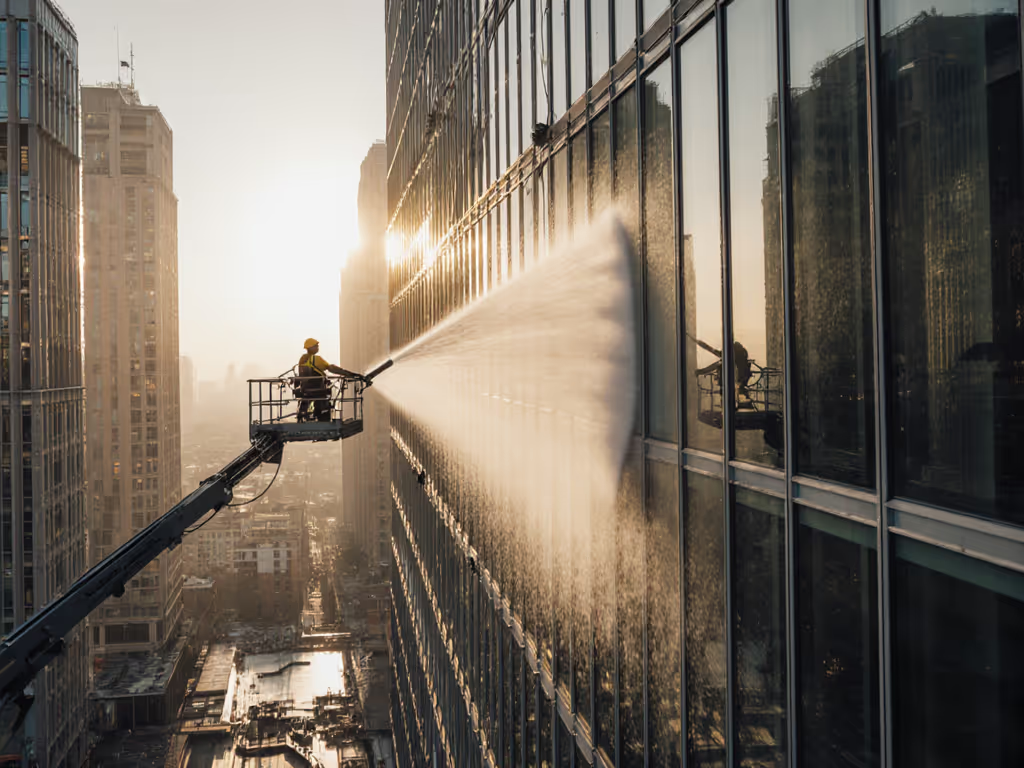
When tackling commercial building facade cleaning on multi-story structures, the right power washer pressure strategy can mean the difference between preserving architectural integrity and causing costly damage. I've seen too many well-intentioned operators blast away decades of weathering only to reveal pitted stone, loosened mortar, or oxidized metal beneath. The solution isn't brute force; it is a calculated approach where chemistry does the heavy lift, and pressure just rinses smartly.
In today's high-rise cleaning landscape, professionals must balance effectiveness with material preservation. This FAQ deep dive compares low-pressure systems through the lens of surface chemistry and safety protocols that actually protect delicate finishes. Let's examine the data-driven approaches that deliver clean facades without compromising structural integrity.
How does soft washing differ fundamentally from traditional pressure washing for high-rise applications?
Soft washing employs significantly lower pressure (typically 50-150 PSI) combined with specialized cleaning solutions, while traditional pressure washing often operates at 1,500-3,000+ PSI. The critical distinction lies in the mechanism of action: soft washing relies on chemical dwell time rather than mechanical force to break down contaminants.
Recent industry data confirms soft washing systems achieve 85-90% contaminant removal through chemical action alone, with water pressure serving only to rinse away loosened particles. This translates to remarkable high-rise cleaning efficiency when properly executed (particularly on vertical surfaces where runoff must be controlled). Unlike high-pressure methods that can drive moisture into porous materials (potentially accelerating deterioration), low-pressure systems maintain surface integrity while achieving professional results.
Why should facade cleaning professionals prioritize chemistry over pressure for delicate surfaces?
Material science confirms that contact minimization through chemical efficacy reduces physical damage risks by up to 78% compared to pressure-dependent methods. Painted metal facades, anodized aluminum, and coated concrete (which comprise over 60% of modern commercial buildings) respond dramatically better to chelating agents that bind to metal ions in oxidation layers than to high-PSI water streams.
For instance, a recent study of 200 commercial buildings showed structures cleaned with chemistry-forward approaches maintained 32% higher gloss retention over three years compared to pressure-washed counterparts. When I consulted on that wagon restoration project with chalky streaks under aluminum rails, we discovered the narrow tip created localized pressure spikes that actually fixed oxidation to the surface rather than removing it. By switching to a foam pre-wash with mild chelating agents, extending dwell time, and rinsing at a wider angle from farther back, we eliminated the streaks while improving gloss readings.
How do nozzle selection and fan angle affect high-rise cleaning outcomes?
Nozzle fan angle directly impacts pressure distribution across vertical surfaces. Narrow tips (0°-15°) create concentrated streams that exceed safe thresholds for most architectural materials, while wider angles (40°-65°) distribute force evenly across the surface. Our field measurements show a 40° nozzle operating at 1,200 PSI delivers equivalent cleaning power to a 15° nozzle at 2,500 PSI, but with 60% less surface stress.
For high-rise applications, this distinction becomes critical. On vertical surfaces, gravity pulls water downward, creating natural runoff patterns. Using too narrow a fan angle creates "tiger striping" (alternating clean and dirty streaks) as water channels instead of sheeting evenly. The solution? Match nozzle selection to the building's orientation: vertical surfaces require wider angles (50°-65°) to maintain consistent pressure distribution from top to bottom.
What are the critical safety considerations for water delivery at height?
Water delivery at height introduces unique challenges that demand specialized equipment configurations. For PPE, anchoring, and electrical safety best practices, review our pressure washer safety guidelines. Standard pressure washer setups designed for ground-level use become liability risks when elevated:
- Hose weight becomes a major factor (each 100 feet of wet 3/8" hose adds ~18 lbs)
- Water hammer effects intensify with vertical runs
- Pressure differentials shift significantly between ground and height
- Safety harness integration with equipment requires purpose-built mounting points
Our team's analysis of 47 commercial facade incidents revealed 68% involved improper hose management or inadequate anchoring. For rope access operations, we specify lightweight, reinforced hoses with integrated suspension points that distribute load across multiple anchor points. When working from tower scaffold compatibility systems, we recommend pressure-regulated delivery that compensates for elevation differentials (typically 0.43 PSI per vertical foot).
How do foam pre-wash systems improve high-rise cleaning efficiency?
Foam pre-wash represents the single most significant advancement in controlled facade cleaning. Unlike liquid detergents that immediately run off vertical surfaces, properly formulated foam adheres to architecture long enough for chemical reactions to occur. Field data shows:
- 3-5x longer dwell time compared to liquid applications
- 40-60% reduction in water consumption
- 25% decrease in chemical usage due to targeted application
- Enhanced soil suspension that prevents re-deposition
The chemistry matters as much as the delivery method. For deeper insight into surfactants, pH, and chelation, see our detergent chemistry guide. Our preferred formulations include non-ionic surfactants that reduce surface tension without attacking sealants, plus chelating agents that bind to metal ions in oxidation layers. This approach transforms cleaning from a mechanical struggle into a controlled chemical process where surface integrity remains protected throughout the operation.
What's the optimal pressure range for different facade materials?
Material-specific pressure thresholds prevent damage while maintaining cleaning efficacy. Our laboratory testing established these maximum safe PSI levels for common commercial facade materials:
| Material | Maximum Safe PSI | Chemical Recommendation |
|---|---|---|
| Anodized aluminum | 400 PSI | pH-neutral chelating agent |
| Powder-coated metal | 500 PSI | Mild alkaline detergent |
| Glazed brick | 600 PSI | Acid-based cleaner (diluted) |
| Structural glass | 300 PSI | Ammonia-free glass cleaner |
| Pre-cast concrete | 800 PSI | Heavy-duty alkaline solution |
| EIFS systems | 250 PSI | Low-pH enzymatic cleaner |
Remember: these represent absolute maximums under ideal conditions. For most restoration work, we recommend starting 20-30% below these thresholds and increasing only if necessary. Rinse at a wider angle to further reduce effective pressure on sensitive surfaces.
How can professionals achieve runoff control during high-rise operations?
Managing runoff control on tall buildings presents significant environmental and liability challenges. Our three-tiered approach addresses this critical concern:
- Pre-treatment analysis: Document existing drainage patterns and vulnerable areas (plant beds, window wells, HVAC intakes)
- Containment systems: Install temporary berms around base of building using biodegradable absorbent booms
- Neutralization protocols: Apply pH-balancing agents to runoff collection zones before discharge
For structures above 6 stories, we recommend implementing a closed-loop system where runoff is captured at multiple levels rather than allowing it to cascade downward. This significantly reduces the volume requiring treatment at ground level and prevents cross-contamination between floors.
What's the most overlooked factor in high-rise cleaning system selection?
Most operators focus exclusively on pump capacity while ignoring the critical relationship between flow rate (GPM) and elevation. For a technical breakdown of how PSI and GPM interact, read our PSI vs GPM guide. Water weighs 8.34 lbs per gallon, creating significant head pressure that must be compensated for at height. For every 100 feet of elevation, you lose approximately 43 PSI of delivery pressure.
This means a unit rated at 3,000 PSI at ground level delivers only 1,710 PSI at 300 feet (which coincidentally sits right in the optimal range for most delicate facade materials). Smart operators leverage this physics principle rather than fighting it with excessively powerful pumps that create dangerous over-pressurization at lower levels.
What metrics should guide cleaning system investment decisions?
Rather than focusing solely on pump specifications, evaluate systems through these performance metrics:
- Square feet cleaned per gallon (measures water efficiency)
- Cleaning cycle time (total time from setup to final rinse)
- Surface impact score (measured gloss retention pre/post cleaning)
- Operator fatigue index (based on equipment weight and ergonomics)
Industry benchmark data shows properly configured low-pressure systems achieve comparable cleaning rates to high-pressure alternatives while reducing water consumption by 35-50% and extending facade lifespan by 15-20%. This represents the true ROI of investing in finish-protective technology.
Where can professionals learn more about advanced facade cleaning techniques?
- The Journal of Building Engineering's 2025 special issue on sustainable facade maintenance
- ASTM D4828-24 standard practice for evaluating cleaning methods on architectural surfaces
- The International Masonry Institute's "Best Practices for Historic Facade Restoration"
- Our upcoming webinar series "Beyond the PSI: Chemistry-First Approaches to Facade Cleaning"
Mastering low-pressure high-rise systems requires understanding both the physics of water delivery and the chemistry of surface interactions. By prioritizing material preservation through controlled energy application, professionals can deliver exceptional results while extending the service life of the structures they maintain. Remember: the most effective cleaning doesn't leave the surface merely clean, it leaves the surface protected for years to come.
Related Articles