Cleaning Units: Match PSI × GPM to Your Surfaces
By Lian Zhou • 19th Feb
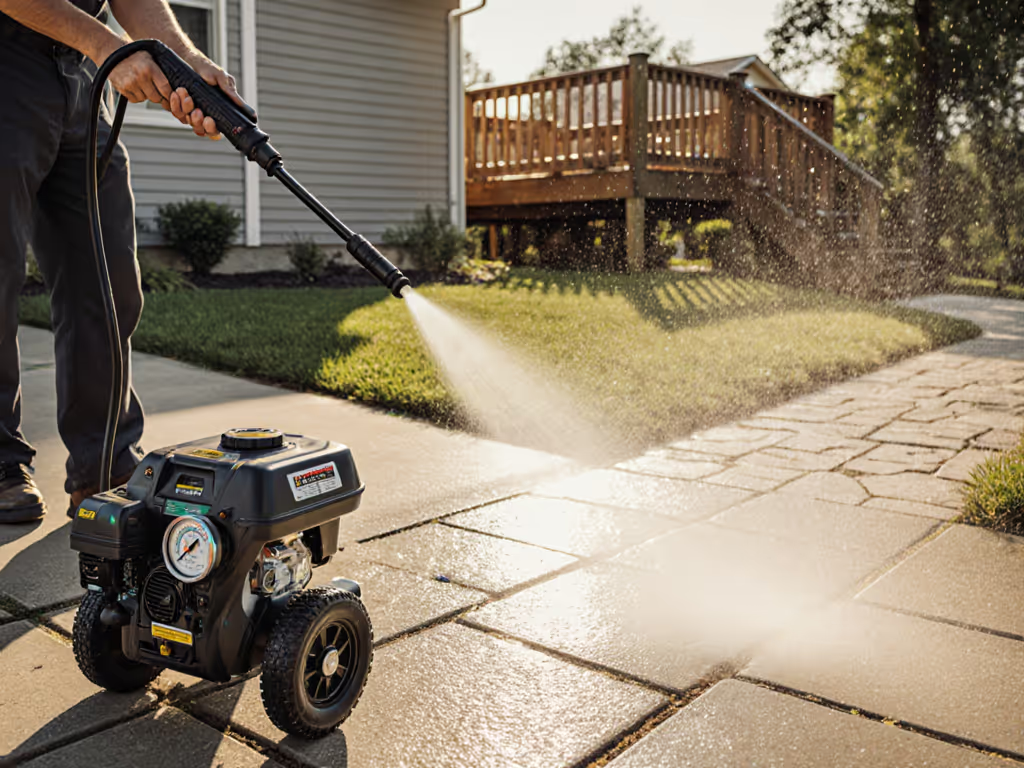
When you're standing in front of a pressure washer spec sheet, two numbers jump out: PSI and GPM. But they don't tell you the whole story. Cleaning Units (CU) is the metric that actually matters, because it is the product of PSI and GPM combined, and it is your key to matching machine performance to what you're about to clean[1][2]. Understanding how to calculate and apply Cleaning Units (CU) to your specific surfaces prevents both underbaked results and expensive damage.
Why PSI and GPM Are Not Interchangeable
Think of PSI (pounds per square inch) as cutting power and GPM (gallons per minute) as rinsing power[2]. PSI measures the force of water striking the surface, and it is what breaks loose stubborn grime and buildup[3]. GPM measures water volume flowing from the machine, determining how quickly you rinse away loosened debris[3]. A high-PSI, low-GPM setup is aggressive but slow; a high-GPM, low-PSI setup is fast but gentle. Neither alone tells you whether a machine will actually clean your deck effectively or damage it in the process. For a deeper breakdown of how PSI and GPM work together, read our PSI vs GPM surface-first guide.
The pressure decreases as distance from the nozzle increases[4]. A machine rated at 3000 PSI at the tip may deliver only 1500 PSI at 12 inches away, a principle experienced operators use strategically. Standoff distance is not just a safety buffer; it's a control knob for pressure intensity on delicate surfaces.
Understanding the Cleaning Units Formula
Cleaning Units are calculated using a straightforward multiplication[1][2]:
$$\text{CU} = \text{PSI} \times \text{GPM}$$
This combined metric reveals overall cleaning performance and allows meaningful comparison across different machine configurations[2][3].
Example comparison:
- Machine A: 3,000 PSI × 2.0 GPM = 6,000 CU
- Machine B: 2,000 PSI × 3.0 GPM = 6,000 CU
Both machines have the same CU value, but they behave very differently on the job. Machine A delivers more stripping force; Machine B covers large areas faster with rinsing power[1]. For wood siding or composite decking, Machine B's profile is safer. For encrusted concrete, Machine A's profile is appropriate, but only if you maintain proper standoff and control.
Step-by-Step: Match CU to Your Surface Type
Step 1: Identify Your Surface Category
Before you touch the trigger, classify what you're cleaning. Surfaces fall into distinct risk bands:
- Delicate finishes: painted wood, cedar, stained composite decking, soft brick, terracotta, stucco joints, vehicle paint
- Moderate surfaces: vinyl siding, pressure-treated lumber, concrete pavers, slate
- Robust surfaces: bare concrete, quarried stone, metal cladding, asphalt
Each category has a finish-safe threshold. For material-by-material techniques and safe settings, see our house pressure washing methods. Start with the surface; pressure is the last knob. Your choice of PSI, GPM, nozzle angle, and dwell time flows from this single decision.
Step 2: Reference Safe CU Ranges
According to cleaning industry standards, gentle washing tasks, such as wood furniture and painted surfaces, demand 1,200 to 2,700 CU, typically using 1,200 to 1,800 PSI and 1.0 to 1.5 GPM[3]. General home cleaning (siding, driveways, sidewalks) sits at 3,000 to 5,000 CU, using 2,000 to 2,500 PSI and 1.5 to 2.0 GPM[3].
These ranges exist because they minimize oxidation risk and finish degradation. They also reflect real-world experience: a 1,100 PSI setting with a 40° nozzle and proper dwell time outperforms a rushed 1,800 PSI blast on delicate wood. Slow is smooth, smooth is fast when the surface stays intact and you don't need rework.
Step 3: Choose PSI and GPM Based on CU Target
Once you know your CU target, you have multiple PSI/GPM combinations that achieve it. Select the one that best fits your job profile:
- For delicate wood or painted finishes: favor lower PSI (1,100 to 1,500) with slightly higher GPM (1.5 to 2.0). The reduced pressure minimizes grain raising and finish crazing. Higher flow ensures rinsing debris away without prolonged dwell, reducing chemical residue.
- For composite or vinyl siding: balance PSI (1,800 to 2,200) and GPM (1.5 to 2.5) to reach 2,700 to 5,000 CU. This range cleans effectively without etching or color bleaching.
- For concrete and stone: you can lean on higher PSI (2,500 to 3,500) with moderate GPM (2.0 to 3.0), because these surfaces tolerate aggressive pressure.
If you're cleaning multiple surface types on the same job, start at the gentlest threshold (wood first, concrete last) and adjust upward only if earlier results don't meet standards.
Step 4: Factor in Nozzle Angle and Standoff Distance
CU tells you the machine's overall power, but the nozzle tip and distance shape how that power lands on the surface[4]. A 40° wide-angle nozzle distributes pressure across a broader area, effectively lowering PSI at any given point. A 0° pencil jet concentrates all force in a tight stream. Never appropriate for delicate finishes. A 25° nozzle is the workhorse for most home cleaning. To keep tips performing consistently, follow our nozzle maintenance guide.
Standoff distance is equally critical. At 18 inches, your 2,000 PSI setting behaves as 2,000 PSI. At 6 inches, pressure intensity multiplies significantly. When cleaning wood, grain direction matters too. Always follow the grain to avoid lifting fibers.
Step 5: Apply Detergent and Dwell Time
Chemistry and time multiply cleaning effectiveness[4]. An oxygen cleaner applied with proper dwell time (allowing the chemical to sit and work) achieves more with lower PSI than force alone. Test detergents on hidden panels first. Dwell time varies by product and surface: 5 to 10 minutes for oxidized siding, 2 to 3 minutes for deck mildew, 10 to 15 minutes for stubborn concrete stains.
This is where precision compounds the safety payoff. Rising grain on cedar or fuzzing on softwood stops when you lower PSI and increase dwell with a finish-safe cleaner. You're trading a few extra minutes for a flawless result and no damage callbacks.
Step 6: Calculate Job Coverage and Water Budget
Higher GPM finishes jobs faster on large areas. Two gallons per minute rinses a patio twice as quickly as one gallon per minute[3]. But water constraints (drought zones, HOA limits, tanker capacity for mobile operators) may cap your flow rate. If you're limited to 2.0 GPM, then reach your target CU by increasing PSI, not hoping for impossible flow rates.
Estimate gallons per job: (square footage ÷ coverage rate in sq. ft. per minute) × your machine's GPM. This calculation prevents costly overruns and informs equipment upgrades. If water is a constraint, use our pressure washer water conservation techniques to reduce gallons per job without sacrificing results.
Step 7: Verify Machine Selection Against Your Needs
Before purchasing or renting, confirm the unit's CU rating aligns with your primary surface type and secondary tasks. A machine delivering 3,000 CU works for gentle wood cleaning but falls short for efficient large-scale concrete. A 6,000 CU unit overkills delicate finishes but excels at covering acreage. Don't buy overpowered when underbaked is the risk on your most precious surface.
Common CU Pitfalls
Chasing CU alone: Two machines with identical CU ratings behave differently depending on their PSI/GPM split. Know the ratio, not just the product.
Ignoring heat and chemistry: CU accounts for pressure and flow, but heat, detergent, and contact time multiply cleaning power several times over[4]. A 2,000 CU setup with hot water and the right cleaner outcleans a 4,000 CU unit running cold water alone.
Mismatching nozzles and orifices: PSI at the tip depends on nozzle orifice size and flow rate. A #4 orifice (industry standard) delivers rated PSI, but a larger or smaller tip changes actual pressure[4]. Verify your tip matches your machine and your target pressure.
Treating all surfaces as concrete: Finish-safe thresholds differ dramatically. What cleans patio pavers aggressively etches brick joints or strips paint. Start conservative; escalate only after test panels prove safety.
Your Action Plan
Begin with a single project and apply this framework:
- Name your surface (e.g., composite deck).
- Look up the finish-safe CU range (here: 2,000 to 3,500 CU).
- Choose a PSI/GPM combination within that range (e.g., 1,500 PSI × 2.0 GPM = 3,000 CU).
- Run test panels on a hidden area: pressure, nozzle, detergent, dwell time.
- Adjust standoff distance and contact time based on test results, not PSI alone.
- Document what worked: surface type, exact setup, outcome, and estimated coverage speed.
This approach transforms CU from a confusing number into a practical decision tool. When you know your surfaces and match machines to them methodically, jobs finish faster, finishes stay pristine, and you stop second-guessing yourself at the start line.
Related Articles